Showing posts with label kale. Show all posts

Friday

The Garden's Plan


definition of "grow" (from the dictionary)

[groh]  verb, grew, grown, grow·ing.
verb (used without object)
1. to increase by natural development, as any living organism or part by assimilation of nutriment; increase in size or substance.
2. to form and increase in size by a process of inorganic accretion, as by crystallization.
3. to arise or issue as a natural development from an original happening, circumstance, or source: Our friendship grew from common interests.
4.to increase gradually in size, amount, etc.; become greater or larger; expand: His influence has grown.
5.to become gradually attached or united by or as if by growth: The branches of the trees grew together, forming a natural arch.

The farm is all about growing—obviously the vegetables we plant, 
but also about our own growth. Others have written about how
 "gardening can be considered a metaphor for life." 
And the more time and effort we spend farming, the more we understand this. 
Executive Chef John Toulze has talked before about how "farming teaches us how to cook," as we pay attention to the seasons of the farm which may or may not 
fit the season as we expect. The ongoing work at the farm teaches us patience in broader ways as well—applied as we work the land, plant the seeds 
and tend our plants as they grow according to their own plan. 

John planting seeds for cover crops
some growing better than others
Then like most important lessons in life, the patience we bring 
to this project somehow becomes a greater part of our lives. 
"The thing about gardening is that you realize you can’t rush things. 
A seed takes a certain amount of time to sprout, no matter what you do."
the collard plants seem to be thriving

broccoli starting to grow

"A plant or tree takes a certain amount of time to grow, flower, 
or bear fruit, no matter what you do—some things grow as we intend, others do not." 
This may seem like a simple concept, but it is often challenging 
to apply to other areas of our lives. 
Which is why gardening is a good reminder to us in how to live. 
Because the garden has its own plan—and the plants, with perhaps 
a bit of help from us, and a lot of nurturing from nature will grow as they will.
Some plants are flourishing at the farm and some are not doing as well.
the lower beds when they were just planted
most of the plants are beginning thriving
but we are not sure about the beets yet
This is especially true at this time of year. 
We worked hard to get the winter crops planted before the rains 
especially the cover crops necessary to nourish the soil 
throughout the winter in preparation for spring planting. 
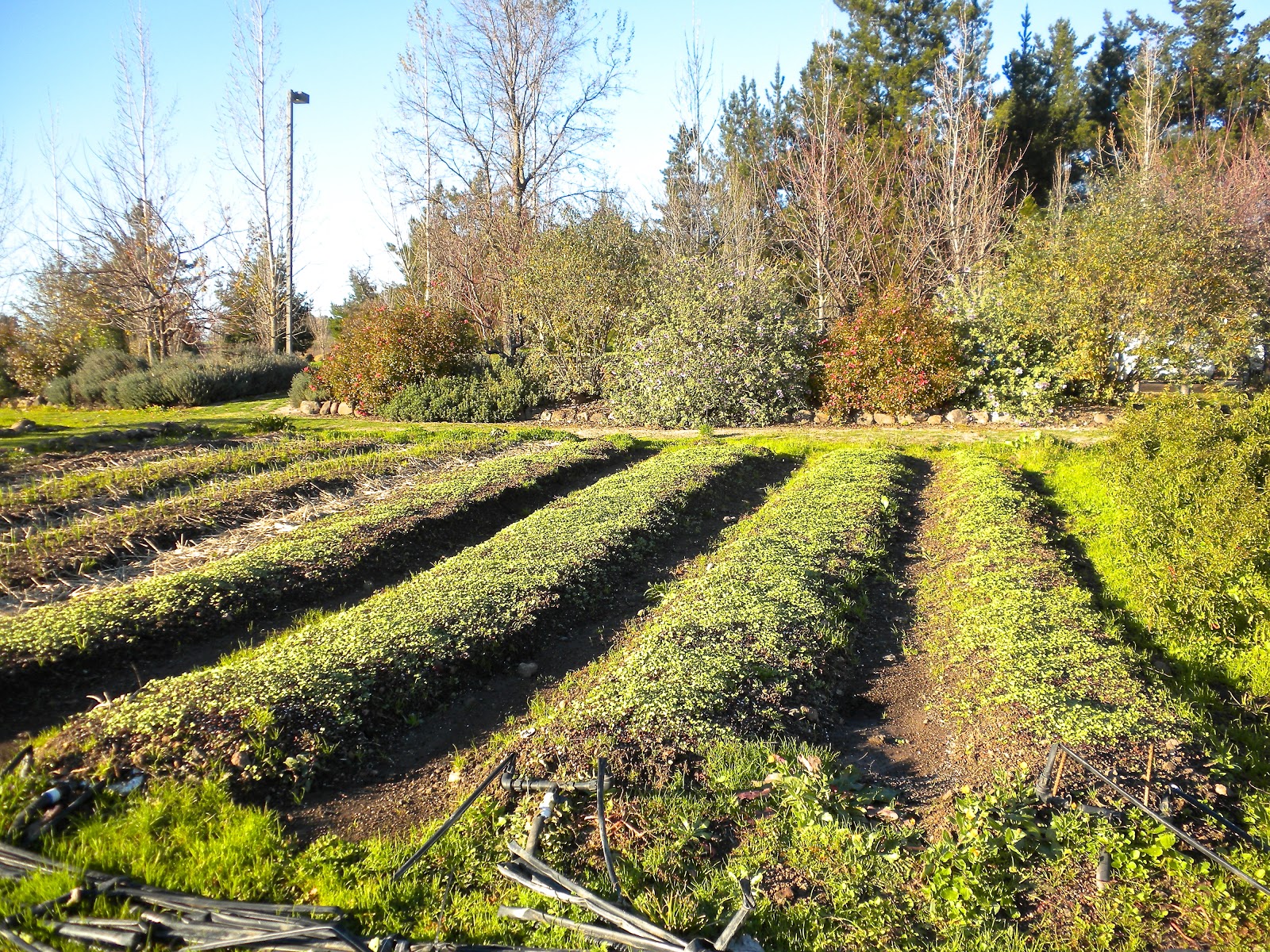
the clover beds will do well this winter
and most of the vegetables in the lower beds
should soon be on the menu at the girl & the fig
radishes are always growing at the farm
photo by Steven Krause
 
to keep up with demand for our heirloom radish starter,
perennial favorite on the menu at "the fig."
Chinese snow peas 
and our lush kale always thrives at the farm

on the menu now at the girl & the fig:
braised short rib, yukon gold potato croquettes, braised kale, natural jus

Do you find gardening meditative? 
Does your time in the garden help you clear your head or find creative solutions? 
Or, does it just help you relax as you muse on what to cook with what you grow?


Saturday

Lovin' our greens

Although there are always a lot of colors at the farm, 
we think of "green" as its signature.
Green being the vibrant color as all plants are growing, 
green being the color of pretty much any "fruit" when it first appears.
Heirloom tomatoes
Celestial fig
green pardon peppers
And of course, "green" now having taken on a larger meaning

Well, at this moment before summer becomes fall 
and the green shimmer at the farm changes to a golden glow 
(tasting those persimmons yet?)
our persimmons last November
We wanted to celebrate our "greens!" 
So, a shout out to our thriving chard and kale plants 
which continue to inspire the chefs.


There always seems to be a dish on the menu at the girl & the fig
 featuring garden greens. Right now we are serving
the panisse cake with a chickpea purée,
sautéed garden chard, and marinated sheep's milk feta.


Most often, like our chefs, you will cook these leafy greens. 
But you certainly can enjoy them raw too. But, how to deal with the bitter taste? 
Eating Well magazine shares the secret on how to "squeeze your greens:" 
"There's an amazing tool for transforming bitter, dark leafy greens 
into a tender melts-in-your-mouth salad.
It's only an arms length away, and it costs nothing: your hands!   

Seriously, try this. It will expand your idea of a salad. 
It's a quick process and retains much of the nutritious benefits to the greens. 
There's been a lot of talk lately this new way to "love" your greens:  
"It's almost like kneading bread dough. It only takes a couple of minutes,
but you'll be amazed at the difference. 
That tough cellulose structure breaks down — wilts, actually — 
and those leaves that once seemed so coarse and fibrous turn silky. 
You can feel it happening. You can see it too — the leaves 
will darken and shrink to almost half their pre-massage volume. 
The flavor changes as well. That pronounced bitterness mellows, 
revealing some of the same depths of sweet green flavor 
you normally get only through long, slow cooking."
greens love you, so love 'em back!
Mom always said it was important to "eat your greens." Here's a new way.
Let us know how it tastes once you've tried it!

Tuesday

Garden "Picks"

Lots to pick at the farm now and every week there are changes. 
The beds planted with winter squash are growing so fast—we just might 
be incorporating those varietals onto the menus 
while we are still getting creative with the summer squash. 
winter squash bed in early July 
and the same bed as August begins
Chef John recently talked to The Huffington Post about 
how the farm tells us what is in season rather than what we expect. 
He recalls: "Nature does not always work in accordance with a chef's schedule. 
You can't predict much. Normally, rhubarb means spring, 
 strawberry is spring and summer, delicata squash is fall. 
There was point last year I was harvesting all those in the same time.
Now, at the height of summer abundance, I'm hauling in tomatoes. 
Every day. We're putting them everywhere on the menu. 
Eggplant? 'Learn to love it,' I tell the sous chefs."
And with eggplant as beautiful as these Black Beauties, what's not to love?
did you know this variety of eggplant is over 100 years old?
these go directly from the farm to the kitchen to your table every day!

Sunset Magazine has a "no fail" guide for when 
to harvest the vegetables in your garden.
This is helpful with so much growing at this time of year. 
What are you harvesting now in your garden?
abundant cucumber bed
Along with our squash,cucumbers, tomatoes, peppers, herbs and eggplant, 
we are also still picking chard and kale.
Here's some "super food" info on kale.

This is a delicious leafy green sautéed or in salads. 
Food writer Melissa Clark offers some delicious ideas for kale, 
including creating kale pesto and a great tip for "cheater's" blanched kale: 
"Before you add your pasta to the pot, grasp a small handful of whole kale 
by the stems, and simply dunk them into and swirl them around 
the bubbling pot for a few seconds. The stems make handles, 
which obviates the need for dropping the leaves into the pot 
and then having to drain said pot and then boil even more water to cook your pasta."

sunchoke plants loom over the squash beds
But what is really growing at the farm are our sunchokes.  
Sunchokes, also called Jerusalem artichokes, are an edible tuber 
that grows underground, much like a potato. 
They look a little bit like large knobs of ginger, and taste slightly nutty, and savory
like a cross between an artichoke heart and the best potato you've ever had.
There are reports of sunchokes growing in Cape Cod in 1605.


Since sunchokes were first cultivated by Native Americans 
and are not from Jerusalem, the reason they are also
called Jerusalem artichokes is unclear.
Does anyone know how they got that name? 


Sondra features a pan roasted black cod with roasted sunchokes in her new book, 
and served it this spring at a dinner we cooked at the James Beard House. 
photo by Phil Gross for James Beard House 
What's the best pick from your garden these days?


Wednesday

Our "go-to" garden

We are back and forth between the Imagery Farm, ESTATE 
and area behind the girl & the fig. 
Right now the winter plants at Imagery are flourishing, 
so we can put some effort into our "go-to" garden at the girl & the fig. 
As usual, herbs will dominate here, making it easy 
for the chefs to grab what they need. 
Our raised beds have always served us well and this season will be no exception. 
last season's herbs in one of the beds 
we are getting started with the herb beds  
Also continuing to thrive in the garden behind the fig 
are nettles, chard and rhubarb. 
In "What's growing" post a few weeks ago, we talked about 
how nettles are considered a "super food," because they are high 
in protein, iron, fiber, Vitamin A & C–making the effort to 
harvest them (3 pairs of latex gloves!) worth it. 
And how they taste in John's ravioli filling 
inspires us to keep them growing. 
Alongside the chard we are planting kale. 
This effort is a true family affair, with John, 
his wife Tina and mom Judy working the beds. 
Maybe this will be a new kind of kale –"Toulze kale!"
porchetta on a bed of polenta and kale
soon these beds will be lush with kale 
One of the signs of Spring is rhubarb and 
what we have growing at the fig is almost 
ready to taste–a tad too tart today 
in November this rhubarb was dormant in the bed at the fig
now the rhubarb is thriving 

almost ready 
waiting for the stalks to get red and ripe

but you can see the red stalks are getting ready
 to soon become our rhubarb tart.

photo of tart by Steven Krause from Plats du Jour book
John and Chef Ashley survey what's growing at "the fig,"
making plans for tending the garden 
and then what they will cook in the kitchen.

Working our gardens is hard but satisfying work.
It feels good to know where our food comes from 
and we take great pride in creating dishes for you, truly from "farm to table," 
something we have been doing for 15 years.
We appreciate that you come to our restaurants for this experience.
It is amazing to us how much we can grow in the garden 
behind the girl & the fig, only about half an acre.

A few posts ago, as part of our promotion of a fundraiser 
for "The Organic Life" documentary, we posted 
this insightful talk by Roger Doiron.
If you missed it, we are sharing it again.
It inspires us to keep growing–and hope it does for you too. 
 (TEDx talk, courtesy of YouTube)