
About a week ago, I received a text from Chef John that said,
"Tomw at the farm. Lot's happening."
So, the next morning, I made sure to be at the farm
armed with my camera and notepad.
Often as I trail after John or Ray and Matt from Local Landscapers,
armed with my camera and notepad.
Often as I trail after John or Ray and Matt from Local Landscapers,
I have to scribble notes so I can keep track of what
they are telling me about everything going on—
not just what's planted where, but the good stuff
about why they are doing what they do—all of which comes naturally to them,
but is new territory for this city girl.
It's those scribbles that ultimately become this blog.
And indeed that day at the beginning of May,
there was "lot's happening."
they are telling me about everything going on—
not just what's planted where, but the good stuff
about why they are doing what they do—all of which comes naturally to them,
but is new territory for this city girl.
 |
| Matt introduces me to a soldier beetle, aptly named as one of the "good bugs" |
And indeed that day at the beginning of May,
there was "lot's happening."

We were all looking ahead to summer as we
set the stage for a bountiful upcoming season.
The morning began with the guys finishing
the prep work in the beds—hard work,
both by hand and tractor to get the farm ready for our planting party that day.


Joining the crew were Seth and Uriel, sous chefs from
the girl & the fig and ESTATE—their hands-on work at the farm
confirms their very personal commitment to "farm to table."
They will truly appreciate whatever they wind up
creating with the peppers they helped plant.
 |
| sous chefs Seth and Uriel |
 |
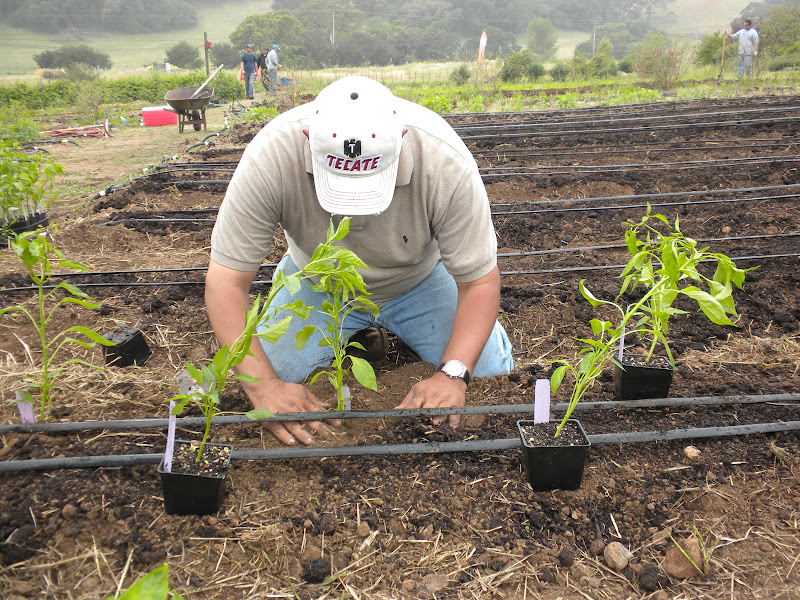
| big moment: the FIRST pepper plant in the ground! |
It is a wonderful part of the cycle of the farm and our kitchens
to have the sous chefs work alongside the regular farm crew.
Executive Chef John Toulze considers his time at the farm some
of his most precious personal meditative time.

Hard as the work is to do,
there is a communal energy between everyone.
there is a communal energy between everyone.
We all work carefully to give the farm as much support as we can,
adhering to biodynamic principles and doing as much as we can by hand.

 |
| freeing the asparagus plant from weeds |
An aspect of biodyanmaic farming that we ramped up
this season is companion planting.
We all think the radishes are even tastier than usual,
so they must like hanging out with the onions!
 |
| radish alternating with onions in one bed |
 |
| photo by Matthew Ruff |
If you want to learn even more, Clare Brandt wrote an intriguing article
on companion planting. Besides the convincing benefits
on what is grown near each other, she reminds us that
some of this is also about what tastes good together.
For instance, it's hard to deny the perfect combo of basil and tomatoes, right?
 |
| photo from Plats du Jour by Steven Krause |
The concept of biodynamic farming goes
beyond simply using organic materials and no pesticides.
As part of the deeper ethical aspects of all this, we appreciate
long standing traditions from natural farming that are still working.
Have you ever heard of "Three Sisters," the Iroquois tradition of
planting corn, beans and squash together?
From this tradition, we are reminded, as Clare Brandt shares in her article, that
"beans
(as all legumes do) take nitrogen from the air rather than the soil
during the growing season, and so don’t compete for nutrients."

While we won't have a "Three Sisters" garden at the farm, we know
we will get some of these benefits to our soil
from the squash we will plant in the Orchard.
But we are thinking about nitrogen and how important it is to our plants.
Knowing that garlic and onion deplete the soil of nitrogen
we needed to replenish the beds before planting our tomatoes, eggplant and peppers.


As we added bat guano, a natural source of soluble nutrients
high in nitrogen and phosphorus,
high in nitrogen and phosphorus,
we were harkening back to another ancient farming tradition.
Did you know that the word "guano" comes from a Quichua language of the Andes
meaning "droppings of sea birds," and
was prized as a soil enricher by the rulers of the Inca Empire?
 |
view from the tractor seat |
In the midst of the planting party,
we continued to harvest what is fresh right now at the farm.
So, while we planted that day for summer, we also
picked pea shoots, garlic and baby carrots
that went straight to the kitchen.

.JPG)

 |
| smoked pea sformato radish salad at ESTATE |
This particular day in May felt like an important one at the farm,
perhaps the start of the farm's summer?
perhaps the start of the farm's summer?
Hands in the dirt, backs bent over, shovels and hoes,
plants from the greenhouse that started as seeds going into the ground
and by afternoon we had planted 100 eggplants, 100 peppers and 150 tomatoes.


 |
| tomato starts ready to climb |
A lot happened.
And a lot more continues for us at the farm project.
More to plant in the upper quadrant, potatoes are growing in the Orchard,
John is deciding what else to plant in the other beds,
a new greenhouse is planned for the half acre behind "the fig"
and more edible plants and herbs will be planted at ESTATE.
 |
| herb beds in front of ESTATE |
Follow along the journey with us as we enter the height of the growing season.
And let us know what you are planting
in your farm project—whether a small backyard space or window sill pots.
Picking something fresh you have grown is a wonder to do and tastes incredible!


