Showing posts sorted by relevance for query companion planting. Sort by date Show all posts

Friday

Is it winter or spring at the farm?

The weather is fickle and playing tricks on our Winter Garden. 
There have been days where it is almost 70 degrees and 
buds are out on some of the trees already. 
celestial fig tree
Nectarine tree

It is unlikely we will see fruit on the trees much sooner than usual,
but the blossoms peeking out are harbingers
of spring and spur us on in our work.
What was even more encouraging was that only six weeks
after planting garlic, we harvested four rows about a week ago,
bringing green garlic to the girl & the fig's kitchen. 

John created a green garlic pistou with striped bass,
artichokes, gigante beans and crispy artichokes
.
Green garlic ready for picking
garlic rows after recent harvest, ready for new bulbs below
Ray and Matt from Local Landscapers were back at it on the farm, 
planting more garlic so we will likely have 
one more harvest from this section of the farm 
before we put in other plants in this area for spring and summer.


Their careful work and the rich soil at our biodynamic farm 
ensure that what we grow is as pure as possible. 
Oyster shells which are pure calcium carbonate, 
are added as a soil amendment because they increase pH levels 
by adding lime and making the soil drain better.

It's as if we have one foot and one hand in our winter garden 

and the other preparing for spring/summer planting.

With the warm weather and our access to the greenhouse, 
we are now planting seeds in addition 
to what we are growing from transplants.  
The eggplants, peppers, herbs and tomato seeds 
will be started in the greenhouse, 
while most of the other vegetables are 
to be planted at the farm.  
We are gearing up to plant 300 tomato plants–just writing about them 
makes my mouth water, how about you?
And while we plan for summer's bounty from our seed packets, 
we continue to work the farm for what we will pick before spring.
In addition to the walla wallas and cipollinis
 we also are growing torpedo and red candy onions.
red candy onions

See the radish sprouts coming up between the red candy onions?
This is part of of our companion planting program
. 

Companion planting is based around the idea that certain plants 
can benefit others when planted close to one another.
We will talk more about companion planting in an upcoming post.

Alongside the 1200 onions John 
and his crew planted lancelot leeks
Can you tell the subtle difference between 
how the leek stalk looks–straighter with a sharp edge, 
than the torpedo onions which are rounder?
lancelot leeks
leek stalk
torpedo onions
You can certainly tell the difference when you are eating them. 
grilling onions in the girl & the fig kitchen
braised leeks w/creme fraiche & truffles photo by Steven Krause

Follow how the companion plants compliment each other.
Tell us what you have been successful planting together. 
By the time we share with you again, we may have harvested 
more from the farm. For sure, we will have planted more!

Sunday

"Lot's happening"

About a week ago, I received a text from Chef John that said, 
"Tomw at the farm. Lot's happening." 
So, the next morning, I made sure to be at the farm
armed with my camera and notepad.
Often as I trail after John or Ray and Matt from Local Landscapers, 
I have to scribble notes so I can keep track of what
they are telling me about everything going on—
not just what's planted where, but the good stuff
about why they are doing what they do—all of which comes naturally to them,
but is new territory for this city girl.
Matt introduces me to a soldier beetle, aptly named as one of the "good bugs"
It's those scribbles that ultimately become this blog.
And indeed that day at the beginning of May,
there was "lot's happening."

 We were all looking ahead to summer as we 
set the stage for a bountiful upcoming season.
The morning began with the guys finishing 
the prep work in the beds—hard work, 
both by hand and tractor to get the farm ready for our planting party that day.


Joining the crew were Seth and Uriel, sous chefs from 
the girl & the fig and ESTATE—their hands-on work at the farm 
confirms their very personal commitment to "farm to table." 
They will truly appreciate whatever they wind up 
creating with the peppers they helped plant.
sous chefs Seth and Uriel
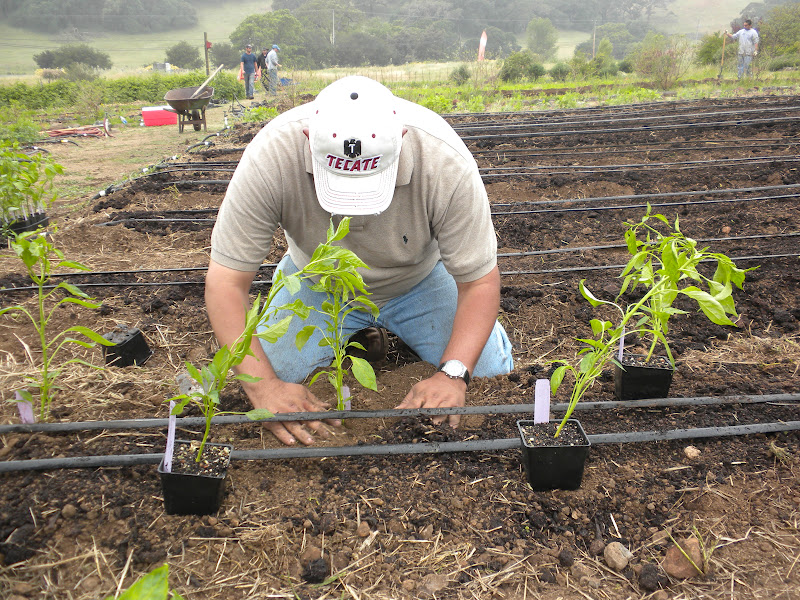
big moment: the FIRST pepper plant in the ground!
It is a wonderful part of the cycle of the farm and our kitchens 
to have the sous chefs work alongside the regular farm crew. 
Executive Chef John Toulze considers his time at the farm some 
of his most precious personal meditative time. 

Hard as the work is to do,
there is a communal energy between everyone.
We all work carefully to give the farm as much support as we can, 
adhering to biodynamic principles and doing as much as we can by hand.


freeing the asparagus plant from weeds

An aspect of biodyanmaic farming that we ramped up 
this season is companion planting. 
We all think the radishes are even tastier than usual, 
so they must like hanging out with the onions!
radish alternating with onions in one bed
photo by Matthew Ruff 

If you want to learn even more, Clare Brandt wrote an intriguing article 
on companion planting. Besides the convincing benefits 
on what is grown near each other, she reminds us that 
some of this is also about what tastes good together. 
For instance, it's hard to deny the perfect combo of basil and tomatoes, right?
photo from Plats du Jour by Steven Krause

The concept of biodynamic farming goes 
As part of the deeper ethical aspects of all this, we appreciate 
long standing traditions from natural farming that are still working. 
Have you ever heard of "Three Sisters," the Iroquois tradition of 
planting corn, beans and squash together? 
From this tradition, we are reminded, as Clare Brandt shares in her article, that 
"beans (as all legumes do) take nitrogen from the air rather than the soil 
 during the growing season, and so don’t compete for nutrients." 

While we won't have a "Three Sisters" garden at the farm, we know 
we will get some of these benefits to our soil 
from the squash we will plant in the Orchard. 
But we are thinking about nitrogen and how important it is to our plants. 
Knowing that garlic and onion deplete the soil of nitrogen 
we needed to replenish the beds before planting our tomatoes, eggplant and peppers.
As we added bat guano, a natural source of soluble nutrients
high in nitrogen and phosphorus, 
we were harkening back to another ancient farming tradition. 
Did you know that the word "guano" comes from a Quichua language of the Andes 
meaning "droppings of sea birds," and 


view from the tractor seat

In the midst of the planting party, 
we continued to harvest what is fresh right now at the farm.
So, while we planted that day for summer, we also 
picked pea shoots, garlic and baby carrots
that went straight to the kitchen.


smoked pea sformato radish salad at ESTATE

This particular day in May felt like an important one at the farm,
perhaps the start of the farm's summer?
Hands in the dirt, backs bent over, shovels and hoes, 
plants from the greenhouse that started as seeds going into the ground 
and by afternoon we had planted 100 eggplants, 100 peppers and 150 tomatoes.


tomato starts ready to climb

 A lot happened.

And a lot more continues for us at the farm project. 
More to plant in the upper quadrant, potatoes are growing in the Orchard, 
 John is deciding what else to plant in the other beds, 
a new greenhouse is planned for the half acre behind "the fig"
 and more edible plants and herbs will be planted at ESTATE.

herb beds in front of ESTATE

Follow along the journey with us as we enter the height of the growing season.
And let us know what you are planting 
in your farm project—whether a small backyard space or window sill pots.
Picking something fresh you have grown is a wonder to do and tastes incredible!


Good for the table, good for the ground

Daylight savings time change confirms we are now officially 
It's the time of year we want to burrow into a favorite sweater 
and are happy to have the aroma of a long 
simmering soup or stew throughout the house. 
Our chefs are also tweaking the menu at the girl & the fig.
A new chicken dish on the menu is this 
pan-roasted half chicken, fall panzanella, butternut squash, 
currants, walnuts, pancetta vinaigrette, which certainly makes 
good use of our prolific crop of winter squash at the farm.
.
It seems to fit the feeling of the season that 
much of what we are growing at the farm burrows underground, 
just the way we are inclined to do under a throw blanket with a book by the hearth.
Even though radishes, carrots, onions and leeks are 
part of the spring bounty at the farm, we also grow them at this time of year as well.
"Plants like onions, garlic, and other members of the allium family confuse bugs 
with their strong scent and just encourage them to fly away," 
so having them in our rotation is a core part of our biodynamic farming plan. 
We've talked about "companion planting" here before. 
Here are some other tips on companion planting and 
which good tasting vegetable plants are also good for your soil.
Baby tri-colored carrots a few weeks ago
carrots growing fast
good for the soil
Not only do the alliums replenish the soil and provide nutrients so 
the beds can thrive throughout the year, these vegetables are 
important ingredients for so many of our Chefs' inspirations.
onions cooking at the fig
Alliums appear in almost every recipe since they are so versatile and 
pretty much essential as flavoring component. 
So, of course we would grow them all year round! 
Shallots are considered a "cousin" to onions and garlic, but they have a milder flavor. 
They are just as "flexible" but chefs use them differently 
than they do their stronger cousins. 
"A shallot can insinuate itself into a wide variety of dishes 
without overwhelming other ingredients.
It is suave and elegant, with an appealing subtlety. 
When it is used with other alliums, any dish blossoms with a full spectrum of flavors, 
which is why I always add shallots of my French onion soup."
She considers them indispensable for vinaigrettes, as do our chefs at "the fig." 
And a must-have in your kitchen are our "Pickled Shallots," courtesy of

Pickled Shallots
2 cups shallots, sliced
11⁄2 cups red wine vinegar 1⁄2 cup sugar
1⁄2 tablespoon salt
1 sprig fresh thyme
1 bay leaf
In a saucepan, combine the wine vinegar, sugar, and salt. Bring to a boil, stirring to dissolve the sugar. Add the thyme, bay leaf and shallots and stir to coat evenly. Cook briskly for exactly 1 minute over high heat and remove from the heat. Allow the mixture to stand until it cools to room temperature. Transfer to a sealed container and refrigerate for up to 2 days.
Makes 11⁄2 cups 

 How do you like to use alliums?
And what vegetables are simmering 
in that stew on your stovetop these autumn days?

We will be transitioning this blog to a different site and hope you will find us there.
If you subscribe to our posts, please change to 
http://sonoma-figgirl.com
We'll post here for awhile longer, but like everything at the farm,
changes occur, so please move along with us.
Thanks for following the blog.