Showing posts with label walla walla onions. Show all posts

Friday

"Cold proofing your salad"


Knowing that the rains were coming, we doubled down 
on what needed to be done at the farm. There was emphasis on 
completing the work on the beds so the soil would be nourished 
and well treated prior to the soaking that is sure to come. 
And on this day of toil, as the days were getting shorter, 
heralding winter, we did our first round of planting 
the vegetables that will be our winter garden.

As we labored, we noticed the last hurrah from summer, 
red peppers still ready for picking, reminded us of summer 
while they resemble Christmas ornaments on a tree. 
By the time you are reading this, the peppers have been picked 
and have lent their tangy spice to one last dish this season. 
But this winter, we will still be able to enjoy our peppers 
from the farm–there are no doubt chili flakes in the pantry 
from peppers John dried on the roof at ESTATE this summer!

The other trophy from this summer's garden are the 
last tomatoes that didn't ripen in time for chef magic, but will 
become part of the rich compost we create as the farm 
changes from one season to the next. All part of the ongoing cycle 
of our biodynamic farm, ensuring the most sustainable use of everything at the farm. 


And, so we are now truly in winter garden mode. 
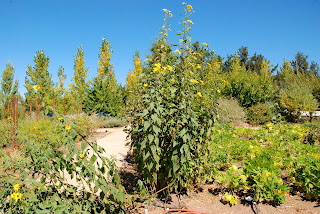
The sunchokes that rose up taller than most of us, are all gone, 
with only a few stubborn tubers still clinging to the ground. 

We've dug those up and cleared away the plants. 
Sunchokes can be obstinate insisting on staying or recurring, 
which is why we planted them at the end of the rows near a path. 
can you believe these "homely" looking tubers would adorn
a dish served at the James Beard house?

But those same deep roots that may be willful about recurring 
bring nutrients far down into the soil benefiting other plants.  
John is still deciding what to plant here. 
While he ponders what to do here in the upper beds,
the plan for the lower beds has been set. We will have 
radishes, chioggia beets, collards, bok choy, Chinese snow peas and broccoli. 
A hearty and diverse winter garden sure to inspire the chefs 
lower beds planted with vegetables

all those veggies as starts in the greenhouse prior to planting
Spicing up the vegetables in our winter garden, 
as well as for the chefs in the kitchens, 
we are growing walla walla and Italian torpedo onions, 
which also were nurtured as starts in the greenhouse 
at "the fig" before planting in the ground. 


row of Italian torpedo onions just getting started
You can be inspired by these reliable vegetables 
whether you are growing them in your winter garden or finding them at a farmer's market. Always good to steam or roast, some of these vegetables can become a winter salad, 
so creative and tasty, it just might rival what you do in the lush days of summer. 
Popular food writer, Mark Bittman recently wrote about "cold proofing your salad:" 
"With all due respect to tomatoes, potatoes, eggplants and all the other vegetables 
we’ve enjoyed for the last few months, the champions of the moment 
are beets, turnips and radishes. Incredibly — though not surprisingly, 
since there are no surprises here — the beets, turnips and radishes 
give you greens to use in salads or for cooking,
 as well as roots you can eat raw or cooked."  
Mark also has some interesting tidbits to share—did you know that 
"beets are chard grown primarily for their roots; 
chard is beets grown for its greens"—and some great recipes. 
the beet salad at the girl & the fig
will be the product of these beets just beginning at the farm

we are always growing chard and radishes at the farm
It's important to us to keep our farm growing even in the winter.

What are you planting for this season? 
Any recipes to share for winter vegetables?

Thursday

1200 onions and 1 greenhouse

We put 1200 walla walla onions in the ground by hand.

It is appropriate that we cultivate walla walla onions, 
given the Mediterranean influence on our cuisine.
The story of the Walla Walla Sweet Onion 
began over a century ago on the Island of Corsica, 
off the West Coast of Italy. It was there 
that a French soldier, Peter Pieri, found an Italian sweet onion seed 
and brought it to the Walla Walla Valley. 
Impressed by the onion’s winter hardiness, 
Pieri, and Italian immigrant farmers who comprised 
much of Walla Walla’s gardening industry, harvested the seed.   


Walla Walla Sweet Onions get their sweetness 
from a unique blending of natural ingredients. 
First, there’s the low sulphur content. 
It’s half that of an ordinary yellow onion. 
Second, Walla Walla Sweets are 90 percent water. 
Finally, combining those elements with a mild climate and rich soil 
grows an onion that’s wildly acclaimed for all its sweetness

two completed rows of onions
ash from ESTATE's pizza oven adds phosphorus to the onion beds

The newest aspect of the farm project is getting access 
to a 100 foot greenhouse. 
This is courtesy of Garden Keepers, CSA, a local company 
that provides organic, sustainable biodynamic 
gardening services to Sonoma businesses. 
Certainly a good fit for our biodynamic farm at Imagery Estate Winery.
Ray and Matt from Local Landscapers 
worked with them to set up the greenhouse 
and we will be able to start some of our plants 
from seeds now instead of having to do all transplants.
rolling out the sheets
holding the sheets down
So, now we will really be nurturing what we plant 
from the very beginning – through all the stages 
of germination, growth and harvest 
to truly bring our bounty to our tables. 
What will be growing here?
The winter garden is taking shape and 
it is encouraging to see some growth.
Not that long ago we were toiling during 
dreary days getting the soil ready.
John keeps a watchful eye on his pet project.
Recently he observed to me that 
"Chefs are completely reliant on farms, 
but most don't get out to them all that often. 
And when they do, it may be to pick something, 
but not that many actually do the farming.
"I want to get close to the ingredients I use when I cook."
And this inspires him.  
I think John is happiest when he is working 
with what we grow–either at the farm or in the kitchen.

I know John is anxious for the harvest we will see from the winter garden.
Soon, you will enjoy that at the restaurants.
And then we will be back at work at the farm 
planting for spring, summer and fall.

As you follow the blog, you will know 
what to expect to see on the table.


Friday

What's growing

The weather continues to taunt us, 
with frosty mornings and nights and then spring—like afternoons. 
The farm is responding well, keeping balance 
with the colder temperatures and embracing the warm days. 

Garlic is sprouting at the farm already and 
lemons are bursting off the trees at ESTATE.

lemon tree at ESTATE
So we are not idle in this winter transition time.
There is a lot of work at the three farm locations.
At ESTATE  and in the farm's Orchard, we are pruning trees
and prepping for spring planting.
Fruit Tree "Ninjai"
Matt with the tiller in the Orchard
Behind "the fig," now that the 300 asparagus plants are in the ground, 
our plan is to continue the chard that did so well and add kale.
Soon the chefs won't have to order Dino Kale, 
they can just go out back and pick what is growing. 

we can get a lot of food growing behind the fig
Alongside these leafy greens are rhubarb 
and stinging nettles continue to grow. 
Even though the chefs have to be careful when 
picking them (they wear 3 pairs of latex gloves), 
we use stinging nettles in some recipes:
They are especially tasting in ravioli filling. 
Did you know that stinging nettles—high in protein, iron, fiber,
 Vitamin A & C—are considered one of the "super foods?"
 It needs to be blanched before using it and 
don't forget those gloves as you handle it!  
The FIGkitchen uses so many fresh herbs that
John decided to expand beyond herb growing
in the raised beds and plant some in a larger section. 
raised herb beds
this large area will give us even more herbs for the kitchen
It is important for us to be self sustainable with all that we use. 
All the restaurant kitchens compost and the kitchen scraps go out to the
compost pile at the farm, enhancing the soil and of course, ultimately 
coming back to the kitchens when we harvest what we've planted. 


We also take the ash from
the pizza oven at ESTATE
and spread it on the beds at the farm.

The ash adds nutrients like
potassium and phosphorus.
Did you know that one pound of ash treats
100 feet lightly dusted?

 The winter garden at Imagery farm now has mustard, radishes, carrots
and beets (chioggia, touchstone gold and merlin varieties)
chioggia beets are the candy striped ones
in the ground along with the garlic.
And, we just planted 1200 walla walla onions!
walla walla transplants
These onions compliment the cipollins we planted. 
The name means "little onion" in Italian and they are 
actually a bulb from the hyacinth plant.  
Check out page 166 in our new book, Plats du Jour 
for a tasty recipe for parsnip and cipollini soup.

And the newest and most exciting development for the farm 
has been putting up a green house which will allow 
us to start things from seeds rather than transplants. 
John and Ray and Matt from Local Landscapers 
have a lot of plans for the greenhouse.

Check back here to learn more about our Green House project
and see our progress with the winter garden at the farm.
And keep following the blog as well as the menus 
at the restaurants to find out what's growing.

Post a question or a comment here—let us know how we are doing.