Showing posts with label radish. Show all posts

Sunday

Vegetable economics


Last week we talked about the overflowing bounty now on display 
at our farm and all the farmers markets stands, and indeed this is that time 
of summer when we get almost giddy about fresh produce.
You can so easily go to the farmers market (or your backyard farm) 
without a specific plan of what you will cook and as you gather what's available, 
your meal will start coming together in your mind. 
(Check out this video from Zagat shopping a Farmers Market with a chef):
All good tips–that is, if you can make it home 
with your treasures before stealing some bites. 
Recently at the Tuesday Farmers Market in Sonoma, a customer 
was inquiring how to store the raspberries he was buying. 
The farmer smiled and said, "Who knows? Most everyone just 
eats them before they get home." 
We know what he means, as our raspberries from the farm 
often don't survive the trip to the restaurant and not because 
they are too delicate to travel, just too delicious to resist!


these managed to make it to the restaurant
and you can enjoy the Summer Crisp of local berries with lemon verbena ice cream
now on the menu at the girl & the fig
Considering how irresistible all the fresh vegetables are this time of year 
and even though we know you are  getting creative, we wanted to share 
some great tips for freezing produce (yes, you can). 
Ok, it's true it may seem like blasphemy to talk about freezing produce 
now when everything is so fresh, but it's a good solution to 
the "I couldn't stop myself from buying everything in sight" affliction 
(or when you can't keep up with what you are growing), 
and later in the year, you'll be glad you did. 
This step-by-step process from what to select, how to cut, blanch and freeze 
is courtesy of Kenji Lopez-Alt, Chief Creative Officer at seriouseats.com 

hard to resist buying it all, right?
On the subject of "vegetable economics," there's also the idea 
of using all the parts of the vegetables you have.
San Francisco Chronicle food writer Tara Duggan has a new book, 
Miriam Morgan explains it this way: "Head-to-tail cooking, the term 
for using every part of the animal, is the mantra of 
sustainably conscious chefs these days. 
Now, a new book translates that into the vegetable realm...
Celery leaves? They go into slaw. Apple peels and cores? 
Make a jelly and flavor bourbon. Too many lemons? Here's how to freeze the zest.

Along with the recipes, the book weighs in on how to 
evaluate organic versus conventional produce; store and prepare produce easily; 
and add meat, fish and chicken into the picture."
There are more good tips on how to use all of a vegetable, including a few recipes.

radish leaf salad with corn, tomatoes & salted cucumbers
photo by Clay McLachlan for San Francisco Chronicle

Our chefs know all these tricks and continue to be creative 
all the time with the bounty we bring them from the farm.
They know all about what to do with lots of cucumbers and tomatoes, 
including the current salad of the season: cucumber vinaigrette, summer herbs, 
lemon cucumber, snap peas, a recent soup special and this week's Plats du Jour entree.
 tomato cucumber gazpacho at the girl & the fig
this week's Plats du Jour features a tomato tart
And they are always inspired by what is currently growing at the farm.
Now, our popular Panisse Cake, which at other times of the year 
is presented with chickpea purĂ©e, sautĂ©ed garden chard 
and marinated sheep's milk feta is now served 
as basil panisse cake~ tomato coulis, cherry tomatoes, 
marinated feta, mizuna, featuring our current garden stars.

Our panisse cake this past winter

current version of Panisse cake using the farm's
basil and tomato 


What are you growing at your farm or finding at the farmers market
that is inspiring you right now?
And do you have any tips for what you do when you have too much?

Monday

Time Lapse at the Farm


Sometimes I wish we had a time lapse camera recording at the farm. 
I am amazed at the changes I find from day to day, and especially week to week. 
While some of this can predict, of course, so much depends 
on the weather and just how the plants "take," 
that often we are surprised at what we find at the farm.
that's purslane growing in the radish bed
although we didn't plant it, we certainly like to use it!

We planted our potatoes at the farm at the end of February 
and soon we will be harvesting them.
The amount of time it takes for potatoes to grow depends on the variety 
(as well as the conditions), but generally fingerlings 
are ready about 100 days from planting.
potato beds late February ready for planting
potatoes getting going
potato beds last week!

We are especially excited about our Russian Banana Fingerling potatoes.  
This variety makes our farm staff and chefs happy:  
 in the Baltic Region of Europe/Asia and are
"heralded as excellent for salads (note to chefs!),
 and are a favorite of among chefs and gourmet markets." (note to diners!). 
Here are some great tips on planting and using Russian Banana potatoes.
notice that the Russian Banana potato flower is purple
while the Yukon golds have white flowers

these blossoms are our indicator
that the potatoes are pretty well set
we will likely pick the potatoes
about two weeks after the plants have lost their blossoms 
While the chefs will be inspired to create with the Russian Bananas, 
we find the Yukon Golds are best for this party nibble:
Photo of Salt Cod & Potato croquettes by Steven Krause
for Plats du Jour: the girl & the fig's Journey Through the Seasons in Wine Country
For fun, here's a time lapse video of a tomato plant growing over 42 days. 


We are counting the days (maybe minutes?) for ours to mature 
and each visit to the farm chronicles how much they are growing. 


last week found our first tomato flower!
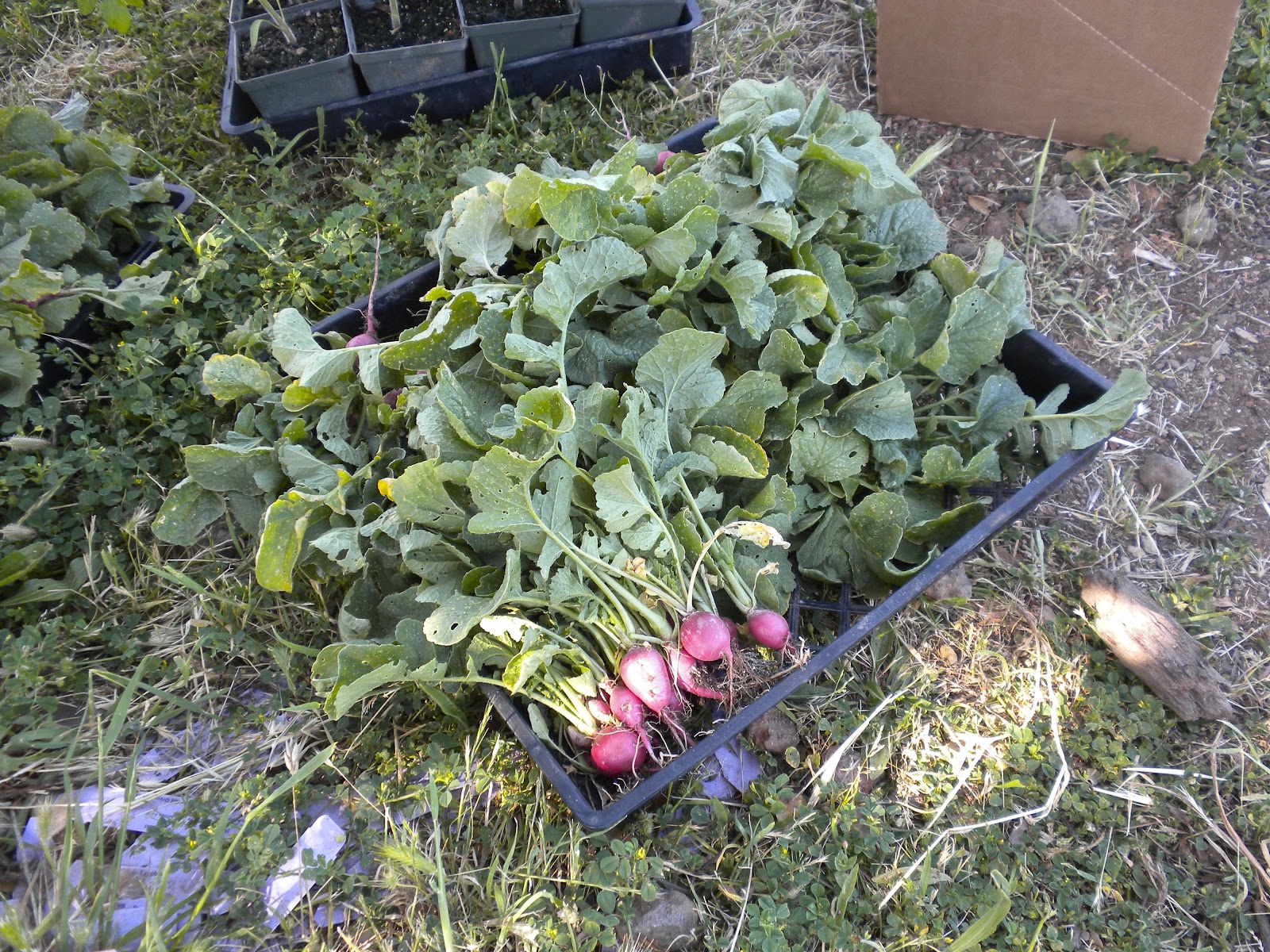
As we are keeping track, we are on our second planting of radishes already, 
having harvested the ones we planted late winter into early spring. 
For our menu at the girl & the fig, we know we always need 
to have radishes going at the farm.

Just picked radishes in April 
one of our most popular starters:
mixed seasonal radishes from our garden, anchovy butter & grey sea salt
Any guess how long it will take for these to get from our farm to your table? 
Follow the blog and you can follow the progress of these radishes!

What are you following in your garden? 
Any tips to share while you wait?

Friday

"Cold proofing your salad"


Knowing that the rains were coming, we doubled down 
on what needed to be done at the farm. There was emphasis on 
completing the work on the beds so the soil would be nourished 
and well treated prior to the soaking that is sure to come. 
And on this day of toil, as the days were getting shorter, 
heralding winter, we did our first round of planting 
the vegetables that will be our winter garden.

As we labored, we noticed the last hurrah from summer, 
red peppers still ready for picking, reminded us of summer 
while they resemble Christmas ornaments on a tree. 
By the time you are reading this, the peppers have been picked 
and have lent their tangy spice to one last dish this season. 
But this winter, we will still be able to enjoy our peppers 
from the farm–there are no doubt chili flakes in the pantry 
from peppers John dried on the roof at ESTATE this summer!

The other trophy from this summer's garden are the 
last tomatoes that didn't ripen in time for chef magic, but will 
become part of the rich compost we create as the farm 
changes from one season to the next. All part of the ongoing cycle 
of our biodynamic farm, ensuring the most sustainable use of everything at the farm. 


And, so we are now truly in winter garden mode. 
The sunchokes that rose up taller than most of us, are all gone, 
with only a few stubborn tubers still clinging to the ground. 

We've dug those up and cleared away the plants. 
Sunchokes can be obstinate insisting on staying or recurring, 
which is why we planted them at the end of the rows near a path. 
can you believe these "homely" looking tubers would adorn
a dish served at the James Beard house?

But those same deep roots that may be willful about recurring 
bring nutrients far down into the soil benefiting other plants.  
John is still deciding what to plant here. 
While he ponders what to do here in the upper beds,
the plan for the lower beds has been set. We will have 
radishes, chioggia beets, collards, bok choy, Chinese snow peas and broccoli. 
A hearty and diverse winter garden sure to inspire the chefs 
lower beds planted with vegetables

all those veggies as starts in the greenhouse prior to planting
Spicing up the vegetables in our winter garden, 
as well as for the chefs in the kitchens, 
we are growing walla walla and Italian torpedo onions, 
which also were nurtured as starts in the greenhouse 
at "the fig" before planting in the ground. 


row of Italian torpedo onions just getting started
You can be inspired by these reliable vegetables 
whether you are growing them in your winter garden or finding them at a farmer's market. Always good to steam or roast, some of these vegetables can become a winter salad, 
so creative and tasty, it just might rival what you do in the lush days of summer. 
Popular food writer, Mark Bittman recently wrote about "cold proofing your salad:" 
"With all due respect to tomatoes, potatoes, eggplants and all the other vegetables 
we’ve enjoyed for the last few months, the champions of the moment 
are beets, turnips and radishes. Incredibly — though not surprisingly, 
since there are no surprises here — the beets, turnips and radishes 
give you greens to use in salads or for cooking,
 as well as roots you can eat raw or cooked."  
Mark also has some interesting tidbits to share—did you know that 
"beets are chard grown primarily for their roots; 
chard is beets grown for its greens"—and some great recipes. 
the beet salad at the girl & the fig
will be the product of these beets just beginning at the farm

we are always growing chard and radishes at the farm
It's important to us to keep our farm growing even in the winter.

What are you planting for this season? 
Any recipes to share for winter vegetables?